If you’ve ever used an Evaporative Air Cooler, you may have noticed a button labelled “Anion”, “Ioniser”, or marked with a small snowflake symbol.
It’s a feature many clients ask about and just as often, it’s misunderstood.
In this article, we explain what the anion (ioniser) feature actually does, what it does not do, and when it makes sense to use it in a real-world event or indoor setup.
What Is the Anion (Ioniser) Feature?
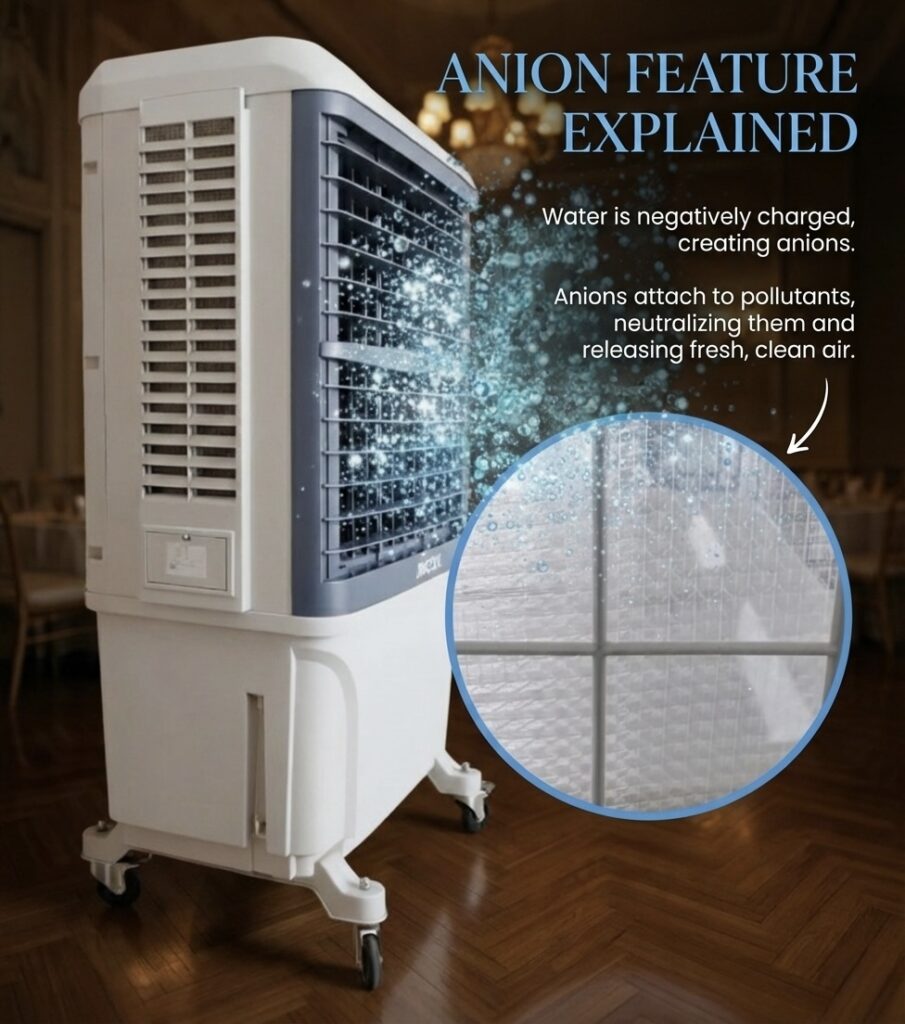
An anion, also known as a negative ion, is a charged particle released into the air by an ioniser.
These negative ions attach themselves to positively charged particles such as dust, pollen, and some airborne pollutants, causing them to become heavier and settle out of the air.
👉 In simple terms, the ioniser is designed to improve perceived air freshness, not to cool the air itself.
What the Anion Feature Does
It’s important to set realistic expectations. When used in the right environment, the anion feature can offer the following benefits:
• Helps freshen indoor air
Negative ions can reduce certain airborne particles, which may help the air feel cleaner in enclosed spaces.
• Can reduce light odours
In indoor venues, especially where people gather for long periods, ionisers may help neutralise mild odours.
• Enhances overall comfort (indirectly)
While it does not change temperature, some people perceive ionised air as more pleasant or less “stale”.
👉 These effects are subtle and situational — they support comfort, rather than drive cooling performance.
What the Anion Feature Does NOT Do
This is where most confusion comes in.
• It does NOT make the air colder
The anion function does not lower air temperature. Cooling is achieved through evaporative airflow, not ionisation.
• It does NOT replace proper ventilation
Ionisers cannot compensate for poor airflow or a sealed space. Fresh air intake is still essential for effective cooling.
• It does NOT remove humidity
Evaporative coolers already add some moisture to the air. The ioniser has no impact on humidity levels.
• It does NOT “clean” large open spaces
In open-sided venues, marquees, or outdoor setups, the anion feature has little to no noticeable effect.
When Using the Anion Feature Makes Sense
❗️ The anion function is most useful in indoor or semi-enclosed environments, such as:
- Indoor corporate events
- Bars, lounges, and entertainment venues
- Enclosed halls with limited airflow
- Spaces where guests remain for extended periods
👉 In these cases, it can complement the cooling system by improving overall air quality perception.
When It Makes Little Difference
You’re unlikely to notice any benefit when:
- The space is open on multiple sides
- The event is outdoors
- Strong cross-ventilation is present
- Cooling demand is driven purely by extreme heat
👉 In these situations, correct cooler placement, airflow direction, and ventilation matter far more than activating the ioniser.
Our Recommendation
At Chill Out | Air Cooler Rentals, we take a practical, honest approach ✅
The anion feature is optional. You’re welcome to use it, but it should never be relied on as a primary cooling solution.
Proper cooler sizing, strategic placement, and fresh air circulation will always have a greater impact on comfort than any auxiliary feature.
If you’re unsure whether it makes sense for your setup, we’re happy to advise based on your venue and event requirements ✅
Final Thoughts
The anion (ioniser) feature can enhance comfort in the right conditions, but it’s not a magic switch. Understanding what it does — and what it doesn’t — helps set realistic expectations and ensures your cooling setup performs as intended.
For added insight and information visit our FAQ page…..


